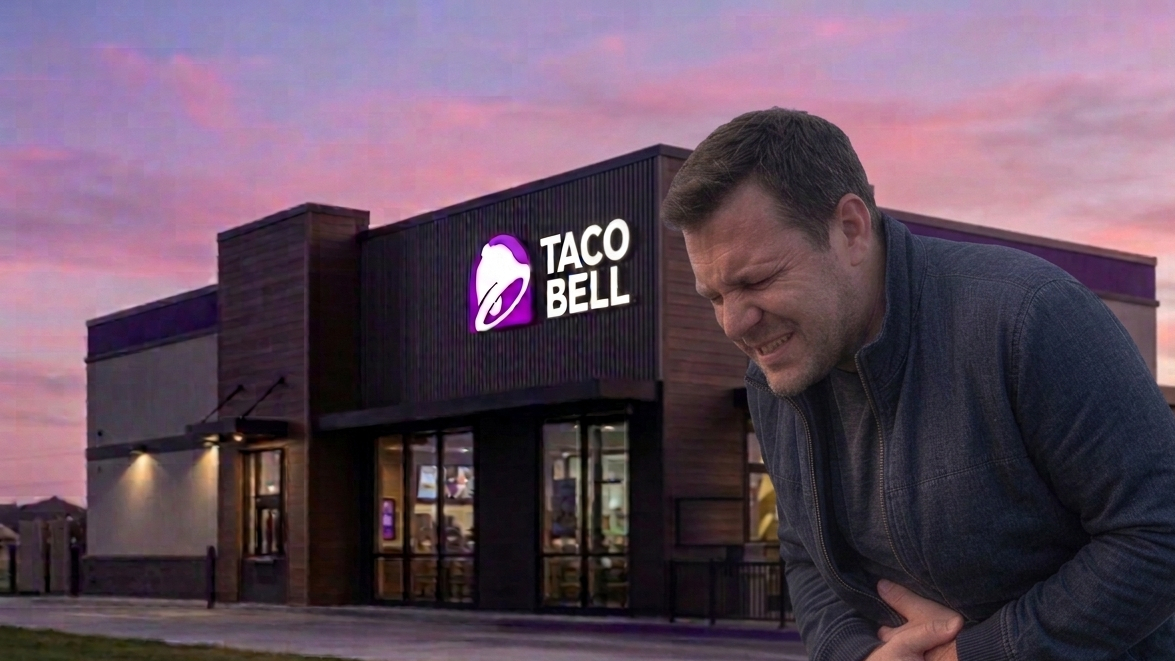
Following a sweeping FDA recall of shredded lettuce due to a massive Cyclospora outbreak, Taco Bell corporate headquarters has issued an urgent public health guide to help consumers distinguish between standard, franchise-approved gastrointestinal distress and a legitimate, parasite-induced medical emergency.
“We want to reassure our loyal customers that the vast majority of severe abdominal cramping and sudden, violent purging taking place across the country right now is just our food working exactly as intended,” said Chief Brand Officer Sean Tresvant, speaking from a sterile press briefing room. “However, the introduction of an exotic, microscopic parasite from imported lettuce has disrupted our ecosystem. It is vital that customers know whether their current agony is a standard byproduct of a $6 Cravings Box, or if they have contracted an actual illness.”
To assist those currently stranded on household toilets, We Deserve an Asteroid has synthesized the official corporate diagnostic criteria below.
The Diagnostics: How to Tell the Difference
- The Onset Timeline: Regular Taco Bell diarrhea occurs within 12 to 14 minutes of consumption, often beginning while you are still idling at a red light on the drive home. Parasite diarrhea, however, has an incubation period of 2 to 7 days, cruelly allowing you to believe you got away with it this time.
- The Primary Fuel: Standard distress is a highly volatile, chemical reaction driven entirely by shelf-stable nacho cheese, ground beef slurry, and carbonated Baja Blast syrup. The parasite version is an aggressive, biologically sentient lifecycle taking place inside your small intestine.
- The Acoustic Profile: If the noises coming from the bathroom resemble a high-powered wet shop-vac clearing a clogged basement drain, that is standard menu performance. If it sounds like a 1990s dial-up modem attempting to connect to a server located in the seventh circle of Hell, seek medical attention.
- The Existential Mood: Normal Taco Bell brings a heavy sense of predictable self-loathing—you knew the risks, you paid your $8.49, and you are quietly serving your sentence. Parasite diarrhea brings pure panic and betrayal. You find yourself bargaining with a higher power you haven’t spoken to since childhood, furious that you were taken down by lettuce.
“Not Like This”
The outbreak has reportedly caused immense frustration within Taco Bell’s culinary R&D department, which has spent decades perfecting a menu capable of inducing immediate, non-parasitic evacuation without federal regulatory interference.
“Our Fire Sauce has been doing the heavy lifting for thirty years,” muttered one visibly exhausted food scientist who spoke on the condition of anonymity. “To have some freeloading tropical protozoan come in here and take credit for the kind of gut-shredding velocity we engineer in a lab? It’s insulting. We want you to shit your brains out, absolutely. But we want it to be on our terms.”
At press time, the FDA reminded citizens that if their stool contains traces of recognizable vegetable matter, it is a guaranteed sign of parasitic contamination, as standard Taco Bell menu items are completely absorbed into the bloodstream as a uniform, neon-orange paste long before reaching the lower intestine.